Nature

November 25, 2026By: Team Dale
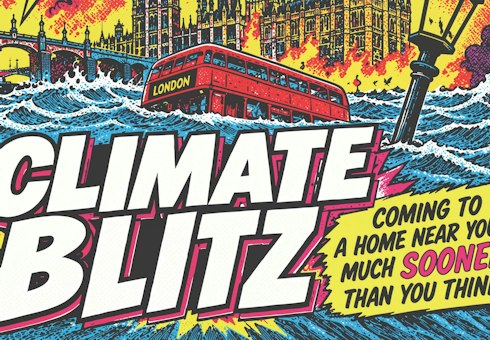
London is under attack. Not from the skies, as it was more than 80 years ago, but from the climate itself – and the bombardment is getting heavier every year.
This summer brought five heatwaves. Before summer had even properly started, Kew Gardens hit 35.1C on 26 May – the hottest May day ever recorded in the UK. The whole country sweltered, but London had it worst, with temperatures in the city running up to 10 degrees higher than in the surrounding countryside.
This is the Climate Blitz. And it's why London is holding its own climate summit, LDN COP, hot on the heels of a UN COP in Turkey that once again saw the world's governments wrestle with words instead of acting – the enlightened pushing for firm commitments to end fossil fuels, the entrenched pushing for anything but.
London can't afford to wait for them. That's the message at the heart of a new manifesto for the capital, published in Babelfish, and it comes down to three things: energy, transport and food – with room made for nature running through all of them.
Cities face the climate crisis with a twist. Pack millions of people, millions of vehicles and mile upon mile of concrete into one place and every problem gets concentrated. Concrete and tarmac soak up the heat of the day and release it slowly through the night and into the next morning, so the city never gets a chance to cool down. City Hall's own analysis, Heat Ready London, found that a million London homes may be at high risk of overheating, with more than 1,300 schools, 60 hospitals and 351 care homes sitting in high heat-risk areas.
Then there's the air. Low emission and congestion zones, along with the steady electrification of our roads, have done a great deal to clean up London's air. But it is still poisonous – and nobody knows that better than Rosamund Adoo-Kissi-Debrah.
Her daughter Ella grew up 25 metres from the South Circular and died in 2013, aged nine, after years of severe asthma. In 2020, a coroner ruled that air pollution had made a material contribution to her death. She is believed to be the first person in the world to have air pollution listed as a cause of death.
Things have improved since then, but we still allow traffic to poison the air we all need to breathe. And as the climate heats up, so does the problem, because extreme temperatures make air pollution worse.
Clean air should be a human right. That's why we're backing Rosamund's campaign for Ella's Law, which would make it one.
It starts with reclaiming our streets. We've organised our cities around the car for so long that we've stopped asking whether it makes any sense. More than four in ten London households don't own a car or van – yet everyone breathes the fumes, hears the noise and dodges the danger. It's the tyranny of the car, and it's time to rebalance the right to drive with the right to breathe.
Oxford Street shows what's possible. Pedestrianised, it has been a success within weeks – good for people and, surprise surprise, good for business too. Who knew? Well, actually, everyone did. Places where people can walk, shop and hang out without being shouldered aside by traffic are places people want to be. We need more of them: fewer cars, more pedestrian zones and more space for people.
And we need more trees. A city without nature is a city that cooks. Trees shade our streets, cool the air around them and help clean it too. London needs rewilding, and LDN COP is making a start in Camden.
Next, we can make our own energy. London has acres of rooftops doing nothing but keeping the rain off. Solar power is a superpower – cheap, simple and democratising, putting energy generation in the hands of ordinary people. Yet Babelfish found that just 7.7% of council homes in England, Scotland and Wales have solar panels.
The prize for changing that is huge. Modelling commissioned by Babelfish found that rooftop solar on suitable social homes could save each household £618 a year, add £5.1bn to the economy and support thousands of jobs. That's how we tackle fuel poverty, the cruel affliction that leaves families choosing between heating and eating – and how London builds real energy independence.
Then there's the part of the climate crisis that no politician wants to talk about: food.
Our diets are driving the climate crisis, the collapse of wildlife, a public health crisis and now Britain's emerging water crisis too. But food is also the one area where every one of us can make a difference, every single day. We all make choices about what we eat, and choosing less meat and dairy is one of the biggest things any of us can do.
Meanwhile, Big Food has taken over our high streets. Babelfish found that every school in Camden has a fast-food outlet within 400 metres. Cheap, dirty and enormously harmful, it's what too many children are growing up on. We control tobacco. We should control fast food the same way. We've reclaimed the streets – now it's time to reclaim the eats.
Energy, transport and food, with room made for nature. These aren't just London's issues – they're the core issues for every city on the planet, both to hold back the climate crisis and to adapt to what we can no longer avoid.
But London can be the city that shows the world how it's done. Make green energy here and solve fuel poverty. Plant more trees and suffer less heat. Fewer cars, cleaner air, better health and more space for people. Cities fit to live in, fit for people – and fit for the climate crisis.
London calling… this is how we beat the Climate Blitz. :)