Government
Peoplenomics: Putting People Back at the Heart of Britain’s Economy
September 26, 2026

May 21, 2026By: Team Dale
Britain’s renewable rollout is finally spreading everywhere. Schools, hospitals, car parks and now even our forests. That’s what progress looks like.
For 14 years the Conservatives wrapped green energy in red tape and called it leadership. Meanwhile the climate crisis got worse and our energy bills shot through the roof. Now we’ve got a government that seems willing to open Britain back up to a bit of common sense… and it’s about time.
Public land is at the centre of the plan. School rooftops, hospital estates, car parks, the seabed offshore… the whole country is being looked at through a simple lens. Where can we make clean energy? And how fast can we do it?
The goal is clear. One hundred per cent green electricity on the grid by 2030.
That’s ambitious, but it’s also necessary. If we’re serious about climate action, energy independence and bringing bills down for good, we don’t have the luxury of taking our time.
Public buildings and public land are perfect places to start. Planning is simpler, the space already exists, and the benefits stay close to home. Every solar panel or wind turbine cuts fossil fuel use and pushes us toward a decentralised energy system that actually makes sense.
And here’s the thing… renewables don’t just cut carbon. They make money.
When a library generates its own electricity from solar panels, it buys less power from the grid. That means lower bills. When a hospital produces more electricity than it uses, it can sell the excess. After years of austerity and energy companies rinsing the public sector, that’s not a small thing.
It’s real money that can go back into frontline services.
And beyond the numbers there’s something else going on. Every solar roof on a school or wind turbine near a community proves a point. Green energy isn’t some abstract idea for the future. It’s infrastructure we can plug straight into everyday life.
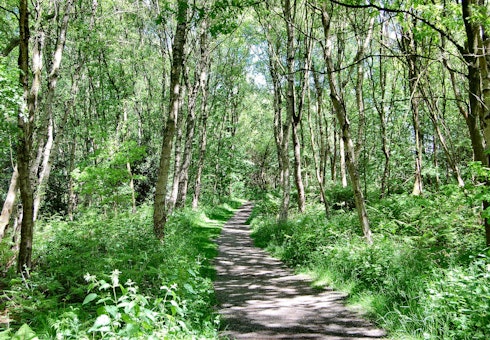
Which brings us to Britain’s forests.
Forestry England manages around 250,000 hectares of land. That’s roughly the size of Northamptonshire. Most of it is woodland, heath and grassland and rightly so - that’s not changing.
But forests aren’t just trees. They come with infrastructure. Buildings, depots, visitor centres and around 500 car parks spread across the estate.
In total there are about 1,500 buildings on Forestry England land. All of them potential hosts for solar panels.
Until recently though, none of that really mattered. Forestry England was stuck in a strange legal grey area that stopped it developing renewable energy on its own property. The result? Out of roughly 2,000 potentially suitable sites, just 40 ended up with solar.
Forty.
That restriction finally disappeared earlier this year. Which means Forestry England can now get on with doing what should have been happening all along, generating clean energy from the land it already manages.
And the benefits go beyond power generation. Every pound saved or earned from renewable energy will be reinvested into woodland management and tree planting.
That’s the bit the net zero culture warriors never talk about.
You’ll hear endless outrage about solar panels supposedly “covering the countryside”. But you’ll hear very little when renewables actively fund nature recovery. This is a perfect example.
Fossil fuels could never deliver that. Even if the economics somehow stacked up (they don’t), Forestry England couldn’t just start drilling or fracking its land. The costs, expertise and infrastructure simply aren’t there.
Renewables are different. They’re scalable, relatively simple and the value they generate stays local.
The government seems to recognise that. Through GB Energy, the publicly owned investment company set up last year, billions are being directed into new clean power. One of its key plans is the Local Power Plan… helping over a thousand communities own a stake in renewable projects in their area.
That matters. Because the faster people see and benefit from green energy, the faster the culture war around net zero collapses.
Once communities are making their own clean power… once bills are lower and energy is local… who in their right mind would want to go back to the fossil fuel rollercoaster?
Probably not many… :)
Government
September 26, 2026
Campaign
September 18, 2026
Government
September 12, 2026
Energy Crisis
August 28, 2026