Government
Peoplenomics: Putting People Back at the Heart of Britain’s Economy
September 26, 2026

September 18, 2026By: Team Dale
First, there was Nigel Farage’s £5 million crypto-bro bung. Then there was a suspicious £500,000 bouncing around his party’s leading figures via an aristocratic mum. Then Farage himself was caught on camera, seemingly thanking ineligible donors for paying for £32,500 worth of polling.
Now all of that has been blown out of the water by two donations to Reform worth £72 million. Seriously. They are laughing in our faces.
Reform has become a doorway through which big businesses and the super-rich, including those based around the world, can try to work their way into our democracy. The party must face the consequences for any illegality that may already have occurred, of course, but here’s the thing... this is bigger than Reform. We have a system-wide problem and it needs a system-wide fix.
Luckily, there is one. It’s simple, cheap and pretty much foolproof.
At the most basic level, private political donations are undemocratic. Our system is supposed to work on the rather simple principle that each of us gets one vote to choose our politicians. Private donations drive a coach and horses through that idea by allowing a small number of very rich people to buy the equivalent of millions of votes’ worth of access and influence over our decision-makers.
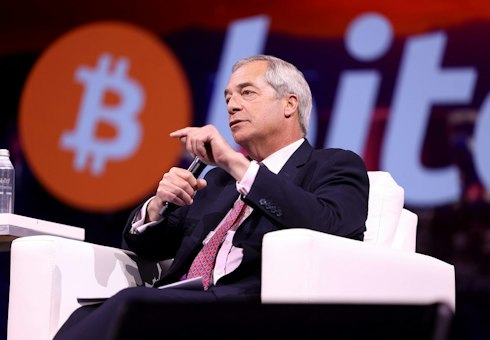
Farage clearly understands how bad this looks. Why else would he have spent so long insisting his £5 million was a purely personal reward, rather than payment in return for anything? Meanwhile, he’s spent years courting the crypto industry while promising deregulation. What a coincidence.
Of course we shouldn’t believe him, and clearly plenty of people don’t. But there’s a bigger point here. Whether political donations actually buy influence in any particular case is almost beside the point, because the suspicion that they might is damaging enough. A healthy democracy requires voters to have faith in the integrity of the system and, most importantly, in the people we elect to run it.
That’s why the perception of sleaze can be every bit as dangerous as sleaze itself. We saw it in 2009 with the MPs’ expenses scandal. Polling afterwards showed that 25% fewer voters were committed to voting in the next general election than before the scandal, while support for UKIP increased significantly.
Strip away the psychology of sleaze and there’s another madness at the heart of private donations. By allowing them, we’re effectively putting our £3 trillion economy up for grabs for a comparatively tiny amount of money. Over the last five years, total donations to all political parties have averaged a mere £50 million a year.
That’s a woefully small price to put on our democracy and the management of the fifth biggest economy in the world.
Labour has moved to limit foreign donations and temporarily ban cryptocurrency donations. That’s a move in the right direction, but these are half measures, and half measures are just waiting to be evaded. In the words of Christopher Harborne, Farage’s Thailand-based serial donor: “I don’t believe the government has a right to stop me, and they won’t. There is always a way.”
He rather makes the point for us.
We can carry on playing donation whack-a-mole, endlessly trying to control where money comes from, how it moves and what form it takes. Or we can tackle the problem at source by scrapping private political donations altogether and replacing them with transparent, accountable, publicly funded politics.
Remember that £50 million figure, the total amount of private donations flowing to our political parties each year? By extension, that’s roughly what it would cost to replace private donations with public money and, with them, remove a huge source of suspicion and sleaze from British politics.
There are plenty of ways we could administer such a system. You can read about some of them here. But take one simple example. We could give every political party with at least one seat in Parliament £50 a year for every member it has. At today’s membership levels, that would cost about £50 million annually. In the context of national spending, that’s basically a rounding error.
And it would do more than simply get private money out of politics. It could improve the health of our democracy in other ways too. Instead of spending their time courting big business, billionaires and wealthy individuals, political parties would have a direct financial incentive to grow their membership, involve more people and build genuine support.
That sounds rather more democratic to us.
Ask almost any politician about public funding and they’ll tell you people won’t wear it. Apparently the public doesn’t want its money used to replace private money in politics.
So we asked the public... and it turns out they actually do.
A majority of people we surveyed, 71%, said they would back a complete ban on political donations if given the choice in a referendum, while twice as many people would choose a publicly funded approach over the system we have today. You can see the full polling here.
Importantly, people support the idea even when they understand that public funding comes with a cost. But, and this is a pretty big but, the cost would be vanishingly small. Roughly the price of a bag of crisps per person each year.
Think about that for a moment. For the price of a bag of crisps, we could remove private money from British politics, stop politicians chasing wealthy donors and take a massive chunk of the sleaze and suspicion out of our democracy.
That’s not an expense. It’s an absolute bargain.
Government
September 26, 2026
Government
September 12, 2026
Energy Crisis
August 28, 2026
Green Energy
August 13, 2026