Campaign
Reform’s donations show why private money has got to go
September 18, 2026

September 26, 2026By: Team Dale
Britain has spent nearly half a century running its economy the wrong way round, putting markets, corporations and capital first while treating the interests of ordinary people as something to deal with afterwards, if there’s any money left. That was the great Thatcher experiment: markets know best, private enterprise does it best, the state should get out of the way and, in her most infamous words, there is no such thing as society.
We’ve had nearly 50 years to test that theory and we can see the results all around us. Working people are paying more tax, wealth gets preferential treatment, energy bills impoverish millions, we don’t build enough homes and public services are permanently told there’s no money. Meanwhile, some of the richest institutions in Britain receive extraordinary sums from the state.
It’s time to turn that thinking on its head.
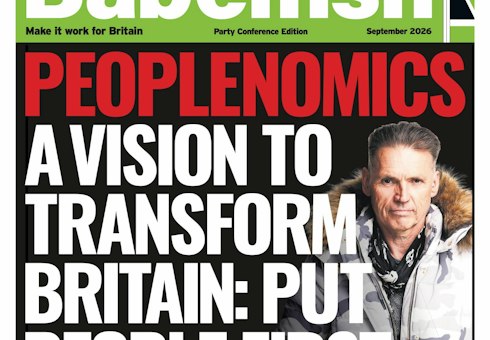
We’re calling the alternative Peoplenomics, and the idea at its heart is simple: put people at the centre of economic decision-making and build the economy out from there. Not because fairness is a nice extra, but because people are the economy. They work, spend, build businesses, pay bills and create the demand that keeps the whole machine turning. Squeeze them hard enough and eventually you squeeze the economy too.
That basic truth has been lost during the long reign of Thatcherism. We’ve been encouraged to believe there is some unavoidable trade-off between doing what is good for people and doing what is good for the economy, as though affordable energy, decent housing and more money in people’s pockets are expensive indulgences. Our work on Peoplenomics shows the opposite.
Independent analysis from the National Institute of Economic and Social Research, alongside work from the Centre for Economics and Business Research, finds that the policies we’re proposing could lift real GDP by 0.6% in the first year and leave it 1.2% higher than it otherwise would have been by year ten. Against current forecasts, that means raising growth by around 60% in year one and more than doubling the present forecast rate by year ten, adding roughly £36 billion a year to the economy. At the same time inflation falls by half a percentage point in the first year.
That’s a pretty profound result from policies whose common feature is simply that they put people first.
A good place to see how badly we’ve got things wrong is income tax. The Conservatives froze the personal allowance for years, which sounds technical until you look at what it actually means. As wages rise, more income gets dragged into tax, so the freeze has quietly taken around £600 a year from working people. For households already dealing with higher food, rent and energy costs, that money matters, and because people on ordinary incomes tend to spend what they have, taking it away also takes demand out of the economy.
Our modelling shows how much of a false economy that is. Restoring the personal allowance produces a near doubling of projected growth in the first year, because £20 billion going back into the pockets of working people doesn’t disappear. It gets spent in shops, cafés, local businesses and all the other places where the real economy lives.
There’s an absurdity in the present system too. We tax people on relatively modest incomes so heavily that many then need support from the state to afford the basics. We take money away with one hand and give some of it back with the other. Why not leave more of their own money with them in the first place?
The obvious question is how we pay for restoring that £20 billion, particularly when we’re constantly told Britain is broke. This is where Peoplenomics exposes another strange feature of the old economic orthodoxy, because while governments agonise over spending on people with very little, we barely question vastly larger sums flowing towards institutions with plenty.
Take the banks. British banks are extremely successful at making money, yet every year we pay them around £30 billion in interest on their reserves. This has helped produce enormous profits, which then leads to calls for windfall taxes to claw some of those profits back.
It’s a wonderfully circular arrangement. We hand over billions, complain when profits soar, argue about taxing some of it back and somehow never question the payment itself.
Reform those payments and we can fund the restoration of the personal allowance, put around £600 a year back into the pockets of working people, stimulate growth and still have billions left over. Instead of cutting benefits for those with the least, we cut what amounts to a benefit for some of the richest institutions in Britain.
The same backwards logic sits at the heart of our energy market. Britain now makes large amounts of relatively cheap renewable electricity, but households and businesses still fail to see the full benefit on their bills because the price of electricity remains heavily influenced by the global price of gas.
It means we can generate power from British wind and sun, with none of the fuel costs or global volatility of gas, and still price that electricity as though it came from an international fossil fuel market.
During the recent energy crisis, we paid around £43 billion more for electricity than we needed to in a single year. That wasn’t £43 billion invested in new infrastructure or jobs. It was simply the consequence of a market design that no longer serves Britain.
Breaking that link is therefore not just energy policy, it’s economic policy. Cheaper electricity puts money back into household budgets while lowering costs for businesses, reducing inflationary pressure and making British industry more competitive. NIESR’s modelling finds particularly strong results from these energy reforms because they work on both sides of the economy at once: raising real incomes while reducing costs for companies.
Once we begin looking at energy this way, the opportunity gets bigger. Britain needs a rooftop revolution, a street-by-street programme to put solar on millions of homes, starting with public and social housing. Done at scale, the economics change dramatically because installation costs fall when you stop treating every roof as a bespoke project.
For households, the benefit could be around £500 a year off energy bills. For Britain, it means more home-grown green energy, less exposure to fossil fuel markets and thousands of jobs. For the state, it can generate a proper return on investment. And because much of the electricity is made where it gets used, it avoids some of the grid constraints currently holding back bigger renewable projects.
Housing tells the same story in a different way. We desperately need more homes, yet the interests of large developers and the interests of the country are not the same. We want plentiful homes at prices people can afford. Their business model works better when supply remains constrained and prices remain high.
We should tax landbanks and penalise unnecessary delays, but we also need to accept something Thatcherite economics made almost unsayable: sometimes the state should simply build things.
There is enough brownfield land for around 1.4 million homes, with roughly half already having planning permission. A national programme to build them could add around £112 billion of value to the economy over a decade and support approximately 370,000 jobs across construction and its supply chains.
Again, the supposed divide between social policy and economic policy disappears.
And that is the central point of Peoplenomics. For decades we’ve behaved as though people doing well is the reward we get after the economy has done well. In reality, the two things are inseparable. A population struggling with unaffordable housing, high taxes and excessive energy bills isn’t evidence of a tough but successful economy. It’s evidence of a failing one.
Poverty suppresses demand. Expensive energy damages industry. Housing shortages hold people back. Taking money from those most likely to spend it weakens the businesses that depend on them.
Economies are built by people, both as workers and as customers. Once we understand that, many supposedly radical choices become obvious. Stop handing vast sums to banks that don’t need them and restore the personal allowance for people who do. Let British households and businesses benefit properly from the green energy we produce here. Put solar on millions of roofs. Build the homes we desperately need. Use public investment to create assets, jobs and economic activity instead of treating every pound spent by the state as money lost forever.
You can call that socialism if you want. We’re not frightened of the word. Affordable energy, decent homes, useful jobs and money in people’s pockets sound like pretty sensible ambitions for any economy, and the independent economic analysis shows these policies can raise growth, lower inflation and improve living standards at the same time.
Thatcherism taught Britain to believe that if we put markets first, people would eventually benefit. Peoplenomics starts from the opposite place: put people first, design markets around their needs and recognise that a stronger society and a stronger economy are not competing ambitions.
They are the same thing.
It’s time for a new economic orthodoxy, and perhaps then we can finally look back on those famous words from Thatcher, not in anger but in relief, and say that while society was always very real, Thatcherism no longer is.
…:)
Campaign
September 18, 2026
Government
September 12, 2026
Energy Crisis
August 28, 2026
Green Energy
August 13, 2026