Government
Peoplenomics: Putting People Back at the Heart of Britain’s Economy
September 26, 2026

July 13, 2026By: Team Dale
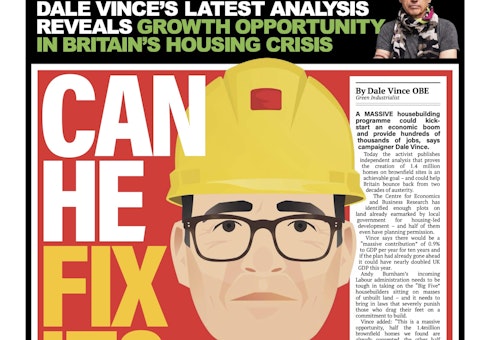
Britain's big five housebuilders sit on 869,000 plots worth £275bn. Our latest edition of Babelfish, Building for Britain research finds 1.4m homes could be built on brownfield land instead.
Britain has a housing crisis. Every year for at least ten years, more people have been born in this country than houses built. And so it deepens.
Ask why and you'll get a shopping list of excuses. We're short of land. We're short of bricks. We're short of builders. It's the newts, the bats, the Swampies, the planning system, the greenies. Someone somewhere is always blocking something.
Our fourth edition of Babelfish takes a deep dive into Britain's housing market, and we can tell you with confidence it's none of the above.
The problem is the market.
We looked at Britain's big five housebuilders. Between them they sit on 869,000 potential homes with a market value of £275billion. At their current rate of building, it will take them fourteen years on average to exhaust that landbank. Fourteen years.
Whether by design or not, these companies all behave the same way. Build slowly. Keep supply tight. Keep prices high. It looks awfully like an “OPEC-style cartel”, where restricting supply is the whole business model.
And if you think that's overstated, consider this: the CMA settled with these firms for £100million last year over the sharing of commercially sensitive information. They barely blinked. Combined pre-tax profits for the big five over the last decade come to £27billion.
Meanwhile 1.3million households sit on social housing waiting lists. It would take England's councils 182 years to clear them at the rate we're building.
Here's what makes this so infuriating. We commissioned the Centre for Economics and Business Research to look at England's brownfield sites — the old factories, the depots, the car parks that sit empty and unloved in every town in this country.
The land already earmarked by local government for housing could support 1.4million homes.
Half of them, nearly 700,000, already have planning permission.
That's enough to meet half of Labour's 1.5million target on its own. No green belt. No new planning fight. No newts.
Build those 1.4million homes over ten years and here's what happens: £259billion of economic value. £89billion of that in construction alone. 3.7million job-years, the equivalent of 370,000 people in full-time work, every year, for a decade.
And for every £1 of public money invested, £1.92 comes back.
That's the kind of return venture capitalists get out of bed for. Bond markets will understand it immediately. The Treasury has already set aside £100billion for investments exactly like this.
Bob the Builder needs to get off his arse. And it isn't complicated, because money is what drives him.
Right now, landbanking is a free ride. A developer gets planning permission and then pays rates on the land as if it were still an empty field, for as long as they like, while the value climbs.
Change that. From the moment permission is granted, start the clock. Let the rates begin their journey towards what would be paid on actual houses. Councils work hard on planning applications, and the whole case for development is the economic benefit that follows. Why should local areas wait years, or even decades, for a benefit they were promised on the day consent was given?
Let them have it. Whether the homes get built or not.
Andy Burnham has spoken out in favour of a national housebuilding programme. He's rumoured to be considering a dedicated department for growth. His instincts are right, and our numbers back him.
Because this isn't just doing social good. It's hardcore economic good.
Britain's housing crisis is a massive problem, socially and economically. But like all problems, change the lens and it's an opportunity.
Let's build the homes Britons badly need, and turbo-charge our economy in the process.
Who knew. Labour has always known...:)
Government
September 26, 2026
Campaign
September 18, 2026
Government
September 12, 2026
Energy Crisis
August 28, 2026